You have the new car. It came with a charging cable. You plug it into a regular garage outlet, come back the next morning, and it has gained about forty miles of range.
Welcome to the moment nearly every new EV owner has, and the reason home charger installation is one of the fastest-growing jobs we do across Southaven, Horn Lake, Olive Branch, Hernando and the greater Memphis area.
Here is a straight explanation of what you actually need, what it costs, and why the answer depends almost entirely on what is inside your electrical panel.
Level 1 versus Level 2: the difference that matters
Level 1 is the cable that came in the trunk. It plugs into a standard 120-volt outlet and adds roughly 3 to 5 miles of range per hour of charging. Overnight, that is somewhere around 40 miles.
If you drive 20 miles a day and the car sits in the garage every night, Level 1 is genuinely adequate and you may not need anything installed at all.
Level 2 runs on 240 volts — the same class of circuit as an electric dryer or range — and adds roughly 25 to 40 miles of range per hour depending on your vehicle and the charger’s amperage. A full overnight charge becomes realistic.
For most households, particularly two-car households or anyone commuting into Memphis daily, Level 2 is what makes an EV feel effortless rather than like something you have to plan around.
Level 3 / DC fast charging is commercial equipment. It requires three-phase power and is not installed at homes.
What it costs in the Southaven and Memphis area
Planning ranges for a residential Level 2 install in 2026:
Simple install — panel has capacity, charger near the panel: roughly $600 to $1,200 in labour and materials
Typical install — moderate wire run through a garage or crawlspace: roughly $1,000 to $2,000
Complex install — long run, exterior conduit, detached garage, finished-wall fishing: roughly $2,000 to $4,000
Install requiring a panel upgrade: add roughly $2,000 to $4,500 for the panel work
The charger unit itself is separate, typically $350 to $800 for a quality Level 2 unit, and many manufacturers include one with the vehicle.
What actually drives that number
Distance from the panel to the charger. The single biggest variable. Ten feet of wire in an unfinished garage is very different from a seventy-foot run to a detached garage.
Whether the path is open or finished. Running conduit through an unfinished basement or attic is straightforward. Fishing wire through finished walls without damaging drywall takes considerably longer.
Amperage. A 40-amp circuit and a 60-amp circuit need different wire gauge, and heavier wire costs more.
Your panel’s available capacity. This is the one that can change your whole budget, so it deserves its own section.
Hardwired versus plug-in. A NEMA 14-50 receptacle lets you unplug and take the charger if you move. Hardwiring is generally the better option for higher-amperage units and outdoor installations.
Permits and inspection. Required for this work and a good thing — it verifies the circuit is safe.
The question everyone forgets: can your panel handle it?
A Level 2 charger is one of the largest continuous loads in a house. Running 40 amps for eight hours straight is a serious demand, and not every panel has room for it.
If you have a 200-amp panel and a reasonably typical household load, you very likely have capacity. This is the common case in newer Southaven and Olive Branch construction.
If you have a 100-amp panel — common in older homes around Memphis, Hernando and Coldwater — it depends heavily on what else is running. A 100-amp service with electric heat, an electric water heater and an electric range may genuinely have nothing left to give.
If your panel is full with no open breaker slots, you may still have options short of a full upgrade, depending on the panel type.
An electrician determines this with a load calculation, which accounts for your service size, your existing loads and the new charger. It is not guesswork, and it is the first thing that should happen before anyone quotes you a price.
If the calculation shows you need more capacity, a panel upgrade is the answer — and it is rarely wasted money. A modern 200-amp panel supports the charger, plus future heat pump, induction range or generator additions. Our guide to residential panel upgrades explains what that process involves.
There is also a middle path worth asking about: load management devices and power-sharing chargers can allow an EV charger on a panel that would otherwise be maxed out, by throttling charging when household demand is high. Whether that suits your situation depends on your specific loads, and it is worth raising during the estimate.
What the installation day looks like
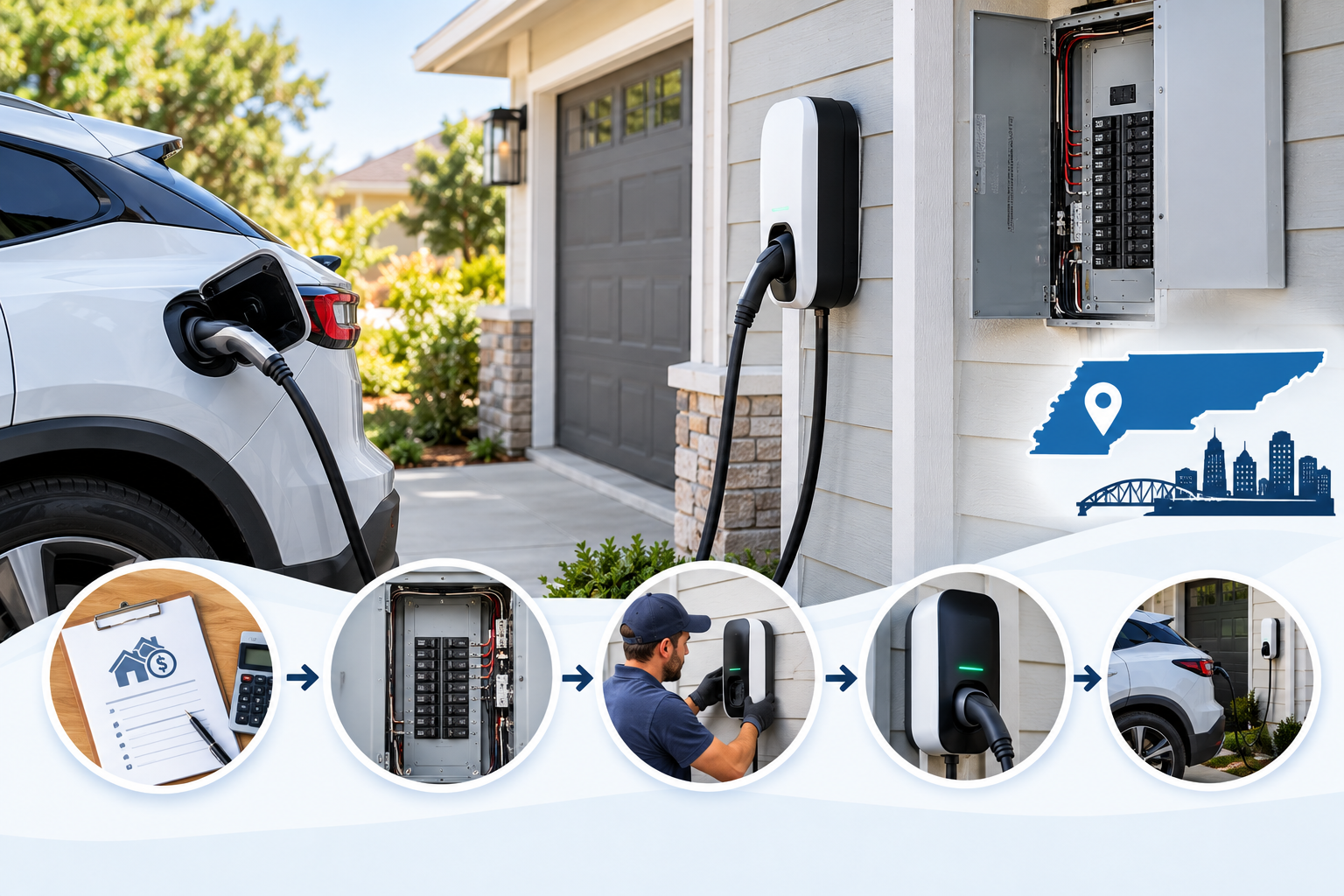
- Site assessment and load calculation. We look at your panel, discuss where you want the charger, and confirm your service can support it.
- Permit. Pulled before work begins.
- Circuit installation. A dedicated 240-volt circuit is run from the panel to the charger location, with the correct breaker and wire gauge for the amperage, and a GFCI breaker where code requires it.
- Mounting and connection. The charger is mounted at a sensible height, and the cable-reach geometry is checked against where you actually park. It sounds minor. It is the detail people most often regret.
- Testing. Voltage verified, connection tested with the vehicle, operation confirmed.
- Inspection. The local inspector signs off on the work.
Most straightforward installs are completed in a half day to a full day. Add time if a panel upgrade is part of the scope.
Practical decisions worth thinking about beforehand
Where do you actually park? Charge ports differ by vehicle — some are front-left, some rear-right. Mount the charger so the cable reaches comfortably without stretching across the bonnet or being dragged around the car.
Are you buying a second EV? If it is on the horizon, say so. Running a circuit sized for future expansion now costs far less than doing the job twice.
Indoor or outdoor? Outdoor installs need weather-rated equipment and enclosures. Perfectly routine, but it affects material selection.
Hardwired or plug-in? Plug-in offers flexibility. Hardwired is generally preferred above 40 amps and in outdoor locations.
Incentives. Federal, state and utility incentives for home charging equipment and installation change periodically. It is worth checking what is currently available through your electric provider before you buy, since the answer moves.
Why Southaven homeowners call Sandoval Electric
We are a local electrical contractor serving Southaven, Horn Lake, Hernando, Olive Branch, Nesbit, Byhalia, Walls, Coldwater, Como, Senatobia and Lake Cormorant, along with Memphis, Bartlett, Collierville, Germantown, Lakeland, Millington, Arlington, Oakland, Piperton, Rossville and Sommerville.
EV charger installation sits alongside our panel upgrades, electrical troubleshooting, lighting installation, general repairs, home generators and electrical renovation work.
That breadth matters on an EV install, because a charger is rarely a standalone job. It is a conversation about your whole electrical service and what else you are likely to add over the next decade.
See recent work in our project gallery, read our customer reviews on the about page, and check the full coverage map on our service areas page.
Frequently asked questions
How long does EV charger installation take?
Most straightforward installs are done in a half day to a full day. If a panel upgrade is required, plan on an additional day.
Do I need a permit to install an EV charger in Southaven?
Yes. A new 240-volt dedicated circuit requires a permit and inspection. We handle the paperwork and coordinate the inspection as part of the job.
Can I install a Level 2 charger with a 100-amp panel?
Sometimes, depending on your other loads. We perform a load calculation to determine it properly. If capacity is short, options include a panel upgrade or a load-management device.
Should I hardwire the charger or use a plug?
A NEMA 14-50 receptacle gives you flexibility to unplug and take the unit with you. Hardwiring is generally recommended for higher-amperage chargers and outdoor installs.
Can you install a charger in a detached garage or carport?
Yes. It requires a longer run and often underground or exterior conduit, which affects the cost, but it is routine work.
Do you install commercial EV charging for businesses?
Yes. Multi-unit and workplace charging fall under our commercial electrical services. Reach out and we will scope it.
Get a real quote for your home charger
Every house is different, and the honest answer to “what will this cost?” starts with a look at your panel.
Request a free EV charger installation quote or call (901) 697-1515. We will run the load calculation, tell you plainly whether your panel can take it, and give you a written price with no surprises on install day.